
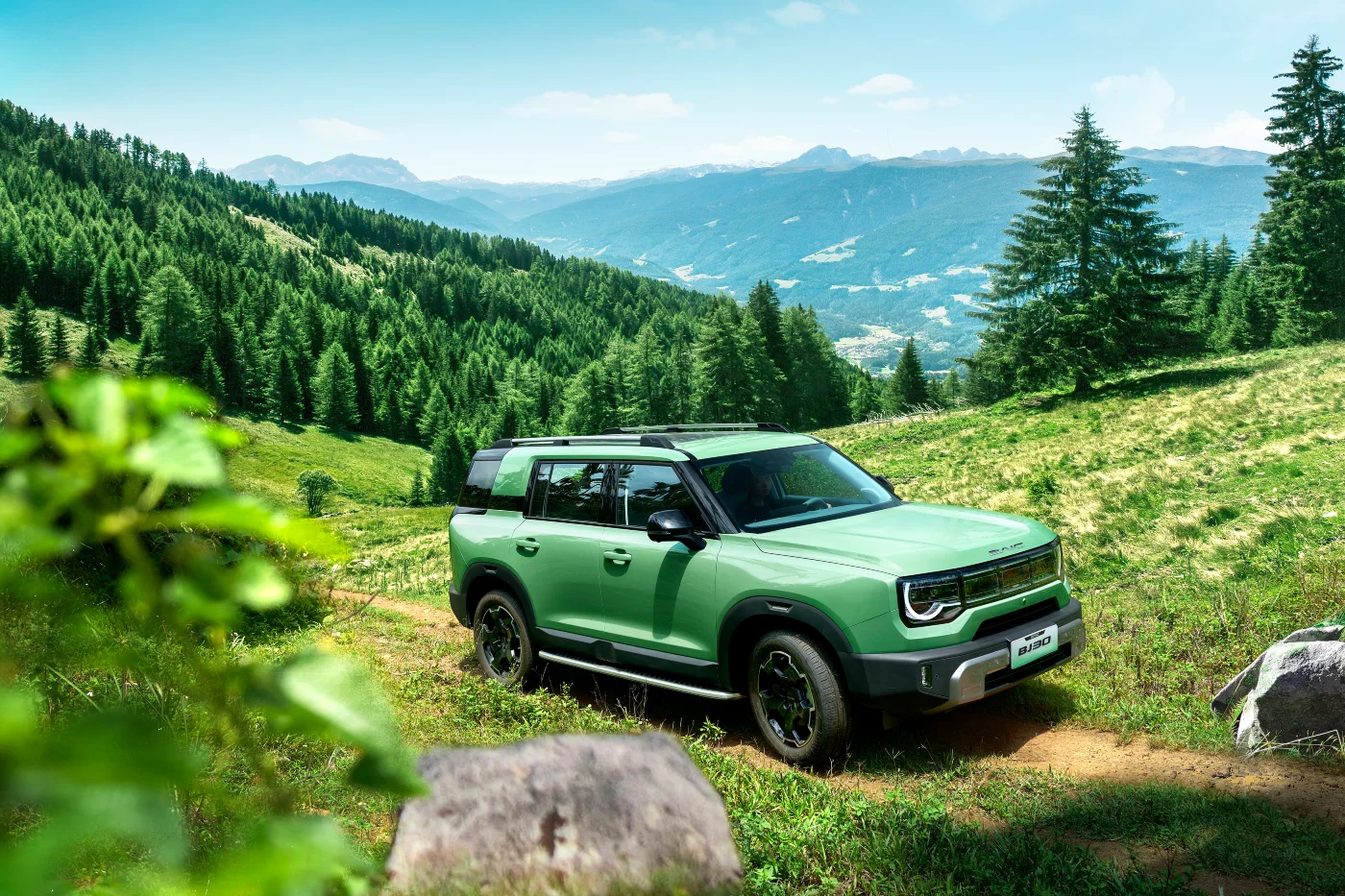
A hybrid that goes off-road
Most hybrid SUVs are built for city efficiency and nothing else. The BAIC BJ30 Hybrid takes a different approach: it pairs a dedicated hybrid transmission with real four-wheel drive, 215 mm of ground clearance and a set of all-terrain modes.
For Bahrain, where a lot of driving is congested urban running punctuated by weekend desert trips, that combination is genuinely useful.
Two versions
The BJ30 is offered in two configurations, and they are meaningfully different.
1.5TD 2WD LV3 — conventional petrol
- 1.5TD engine, 138 kW and 280 Nm
- 7-speed dual clutch
- Front-wheel drive
- 60-litre tank
- 8.06 L/100km
- Kerb weight 1600 kg
1.5T DHT 4WD LV5 — the hybrid
- 1.5T engine, 115 kW and 230 Nm
- Two electric motors: 130 kW / 315 Nm and 55 kW / 135 Nm
- Dedicated Hybrid Transmission (DHT)
- Real-time four-wheel drive
- 51-litre tank
- 6.45 L/100km
- Kerb weight 1770 kg
The headline is the consumption difference: 6.45 against 8.06 litres per 100 km, a reduction of about 20 percent, while the hybrid also gains four-wheel drive.
How the DHT system works
A Dedicated Hybrid Transmission is built specifically for hybrid operation rather than being a conventional gearbox with a motor bolted on. In practice:
At low speed and in traffic, the electric motor does most of the driving. The petrol engine either stays off or runs at its most efficient point to generate electricity. This is where the fuel savings come from — stop-start traffic is exactly the condition that wastes fuel in a conventional car.
At cruising speed, the petrol engine takes over direct drive, because a combustion engine is efficient at steady highway speed.
Under acceleration, both work together. The combined torque is why the hybrid feels stronger off the line than its engine figures suggest.
There is no plug. The system charges itself through the engine and regenerative braking, so nothing about your routine changes.
Off-road capability
The hybrid 4WD version is where the BJ30 earns its BJ badge:
- Ground clearance: 215 mm
- Approach angle: 24.5 degrees
- Departure angle: 30 degrees
- Ramp angle: 21 degrees
- Real-time four-wheel drive
- All-terrain system: Mud, Sand, Wading
- Electronic limited slip assist
- Speed-controlled hill descent control
- Launch mode
The non-bearing 3D protective body uses a high-strength roll cage with a reinforced joint structure and integrated B-pillar. BAIC states the static roof crush test result exceeds the regulatory standard by 62.2 percent, with the structure absorbing 23 percent of crash energy.
Size and space
- Length, width, height: 4730 / 1910 / 1790 mm
- Wheelbase: 2820 mm
- Five seats
- Rear seats 4/6 folding, second row lies flat
The 2820 mm wheelbase is the same as the much larger BJ60, which explains why rear legroom is generous.
Practical touches aimed at outdoor use: a boot camping table, camp light hooks on the tailgate, a 220V / 150W power outlet in the boot, and roof rails as standard.
Technology, standard on both trims
This is where the BJ30 makes its strongest case. The full driver assistance suite is standard on both the 2WD and 4WD versions:
Intelligent adaptive cruise control, integrated cruise assist, 360-degree 3D camera, rear cross traffic alert and brake, lane departure warning, lane keeping assist, lane change assist, blind spot detection, door open warning, traffic jam assist, forward collision warning, rear collision warning, automatic emergency braking and pedestrian AEB.
Also standard: 14.6-inch central screen, 10.25-inch instrument display, eight-speaker audio, leather seats with electric adjustment front and rear lumbar support, front seat ventilation, driver's seat memory with welcome mode, wireless charging, powered tailgate, rain-sensing wipers, dual-zone climate control with a heated and cooled armrest box, and ISOFIX anchors.
Is the hybrid worth the premium?
The cost calculation depends on your annual mileage, but the fuel figures are only part of it. Choosing the 4WD DHT version also gets you four-wheel drive, the all-terrain system, electronic limited slip and a launch mode. You are not paying purely for economy.
The counter-argument is weight: the hybrid carries 170 kg more.
Book a test drive
Drive both versions back to back if you can — the difference in low-speed response is immediately obvious. Book a test drive or request the brochure.