
The market has changed
Ten years ago, "Chinese SUV" in the Gulf meant a budget alternative. That framing is out of date. Chinese manufacturers now build to Euro VI emissions standards, fit driver assistance systems that were premium-only a few years ago, and supply vehicles to markets with demanding certification requirements.
What has not changed is that buyers are right to ask questions. Here is what actually matters when you are shopping.
Five things worth checking
1. Who is the distributor, and how long have they been here?
This is the single most important question. A vehicle is only as good as the support behind it. Ask how long the distributor has held the franchise, whether they have their own workshop, and how parts are stocked.
BAIC in Bahrain is handled by Khalil Kanoo Motors, with a dedicated service facility, factory-trained technicians and genuine spare parts.
2. What is the manufacturer's actual scale?
Brand history tells you something about engineering depth. BAIC — Beijing Automotive Industry Corporation — has been building vehicles since 1958, including a long-running line of off-road vehicles for demanding use. That heritage shows in the BJ series today. You can read more on the history of BAIC.
3. Is the engineering shared or developed alone?
Co-development is a good sign. The 1.5TD engine used in the X55 and All New X7 was developed with German engineering partner Meta, producing 138 kW and 305 Nm. In the X55 that is good for 0–100 km/h in 7.84 seconds.
4. What safety equipment is standard rather than optional?
This is where the current generation of Chinese SUVs often surprises people. On the BJ30 Hybrid, for example, the standard list across both trims includes automatic emergency braking with pedestrian detection, adaptive cruise control, lane keeping assist, blind spot detection, rear cross traffic alert and brake, door open warning and a 360-degree camera. That is a strong specification at any price.
5. How is the body built?
Look past the equipment list at the structure. The All New X7 uses 75.34 percent high-strength steel with substantial use of 1500 MPa thermoformed steel. The BJ80 uses body-on-frame construction with a bending stiffness of 6100 N/mm and torsional stiffness of 8100 N/mm.
The BAIC range in Bahrain
Nine models, across three clear categories.
SUVs for road use
- X35 — small SUV, 4325 mm, 1.5T CVT, 110 kW
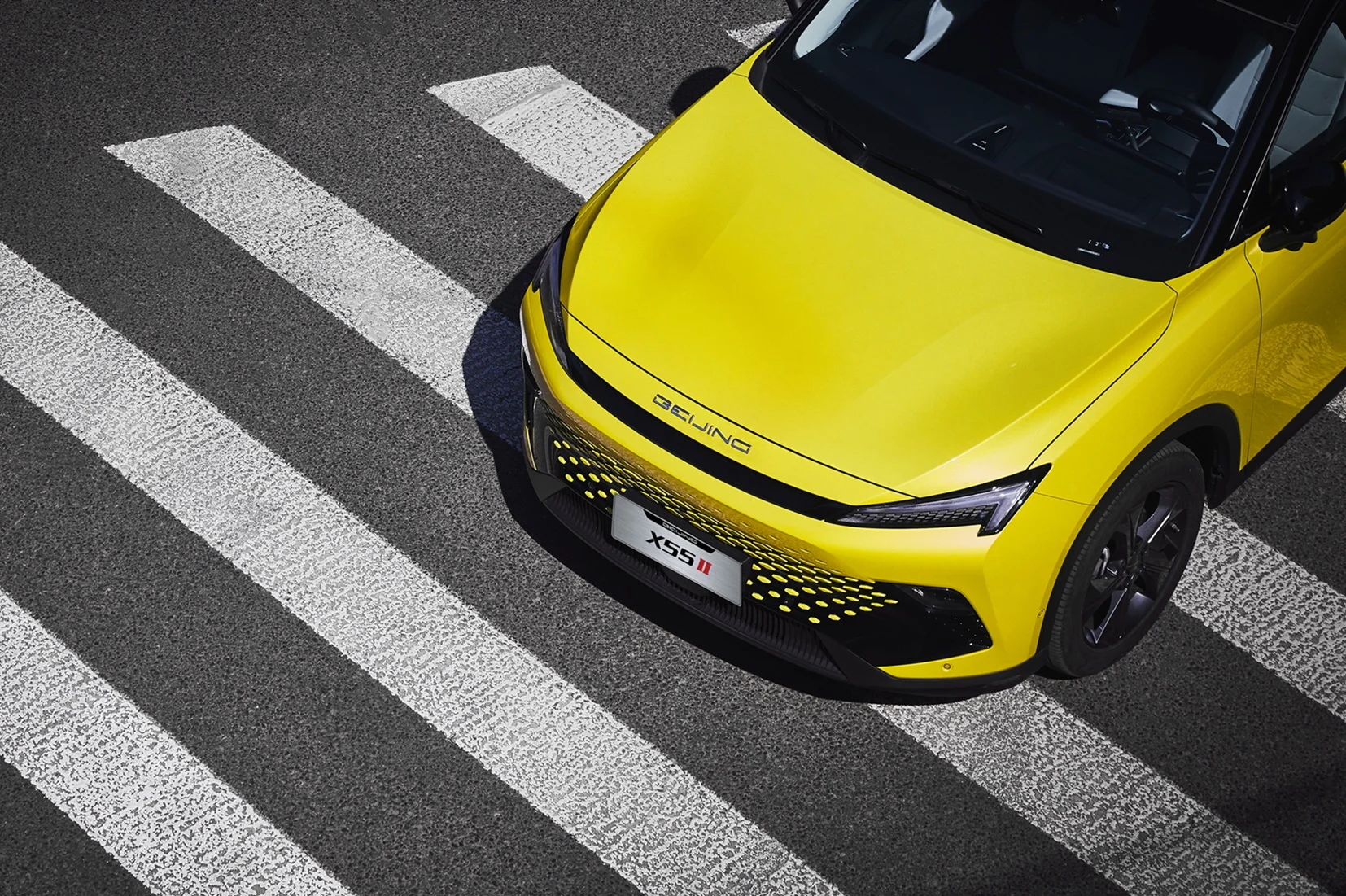
- X55 — compact SUV, 4620 mm, 1.5TD 7DCT, 138 kW
- All New X7 — midsize SUV, 4745 mm, 1.5T 7DCT, 138 kW
Off-road and 4x4
- BJ30 Hybrid — hybrid 4x4, DHT system, 215 mm clearance
- BJ40 SE and BJ40 PRO — dedicated off-roaders
- BJ60 — 7-seater 4x4, 2.0T 8AT, 750 mm wading depth
- BJ80 — 3.0T twin-turbo V6, luxury 4x4
Sedan
- U5 PLUS — compact sedan, 430-litre boot
What to expect on a test drive
Judge these things specifically:
Air conditioning performance. Get in a car that has been parked in the sun and time how long it takes to become comfortable. This is the single most tested system in a Bahrain car.
Gearbox behaviour at low speed. Dual-clutch transmissions can hesitate in stop-start traffic. Drive one in actual traffic, not an empty road.
Screen response. A large display that lags is worse than a small one that does not.
Road noise at 100 km/h. Take it onto a highway. Wind and tyre noise are hard to judge at showroom speeds.
Fuel, servicing and the long view
Most of the BAIC petrol range runs on 92 octane, with the X35 rated for 91. All current models meet Euro VI emissions standards.
For servicing, keep to the schedule in the owner's manual and book through the service scheduling page. Bahrain's heat and dust mean air filters, cabin filters and coolant deserve more attention than a temperate-climate interval suggests.
The honest summary
Chinese SUVs today compete on equipment, technology and warranty rather than price alone. The question is no longer whether they are well built — it is whether the specific model suits your driving and whether the local distributor will still be supporting it in five years.
Go and drive one. Book a test drive or visit the showroom.