
What "4x4" should mean
Plenty of SUVs advertise all-wheel drive. Far fewer are built to leave tarmac. The difference shows up in a handful of specifications that are easy to check and hard to fake.
Approach and departure angles determine whether you can climb onto and off a dune face without burying a bumper. Ground clearance determines what you can pass over. Wading depth determines what you can cross. Differential locks determine whether you keep moving when a wheel lifts. And body-on-frame construction determines whether the structure tolerates repeated twisting loads.
BAIC's BJ series is built around these numbers, which is unsurprising — BAIC has been building off-road vehicles since 1958.
The BJ40 PRO
The BJ40 PRO is the dedicated off-roader in the range.
- 2.0T engine, 241 hp, 305 Nm
- Approach angle: 37 degrees
- Ramp angle: 24 degrees
- Gradeability: 60 percent
- Fording depth: over 600 mm
- Trench crossing width: 500 mm
- Roadblock crossing height: 350 mm
- 11 drive modes
- Military-grade non-load-bearing body
A 37-degree approach angle is a serious figure. It means you can point the nose up a steep bank without contacting the front bumper.
Eleven drive modes is more than most drivers will ever cycle through, but the principle is sound: the vehicle adapts throttle mapping, traction control intervention and braking behaviour to the surface rather than asking you to compensate with technique.
Design details show the intent — a split tailgate, frameless doors, dual screens inside and an outdoor power interface for equipment.
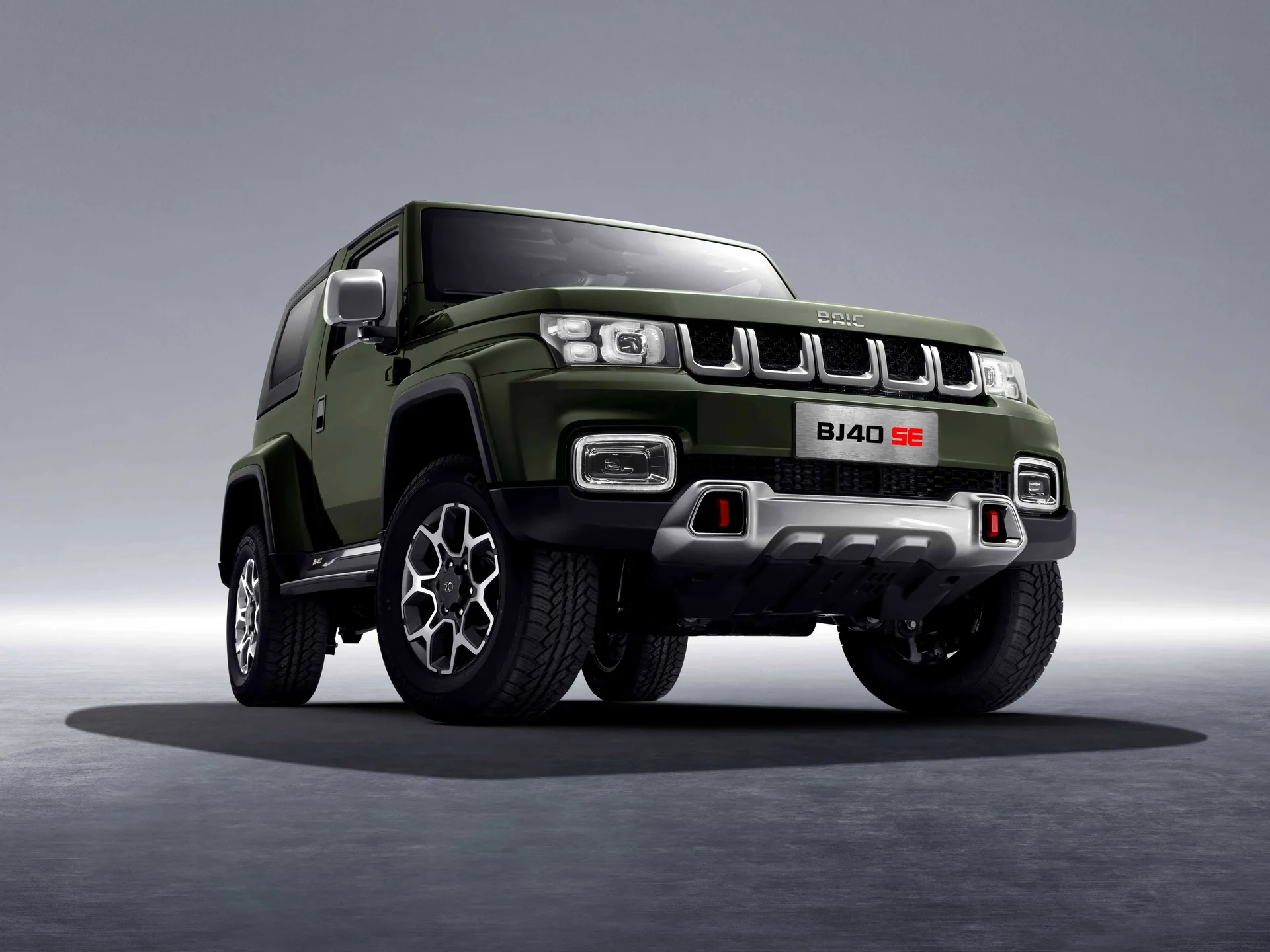
The BJ40 SE sits alongside it in the off-road line.
The BJ60
The BJ60 is the choice when you need capability and seven seats.
- 2.0T with 48V mild hybrid, 185 kW and 400 Nm, 8-speed automatic
- Part-time four-wheel drive
- Ground clearance: 215 mm
- Wading depth: 750 mm
- Approach angle: 30 degrees or more
- Departure angle: 24 degrees or more
- Front and rear electronically controlled differential locks
- Body-on-frame construction
- Drive modes: Sport, Economy, Comfort, Snow, Crossing, Sand, Mud, Rock, plus Wading on Flagship
- Full-size rear-mounted spare
750 mm of wading depth is the standout number here, and the Flagship adds a wading induction system that monitors depth.
Both front and rear differential locks matter. Many vehicles offer a rear lock only. With both, the BJ60 can keep driving with diagonal wheels off the ground — the classic situation that strands a vehicle with open differentials.
The BJ80
The BJ80 is the flagship, and the only V6 in the range.
- 3.0-litre twin-turbo V6, 206 kW and 420 Nm, 8-speed automatic
- Part-time four-wheel drive
- Approach angle: 34 to 39 degrees depending on specification
- Departure angle: 27 to 33 degrees
- Ramp angle: 25 degrees
- Body-on-frame
- Double wishbone torsion bar front suspension, five-link coil rear
- 275/50 R20 tyres, full-size spare
- Front and rear tow hooks, two of each
- 85-litre tank
The suspension layout is worth noting. A torsion bar front end with a live rear axle on coils is a deliberately traditional off-road arrangement chosen for articulation and durability rather than road refinement.
Inside, it is a different vehicle entirely from its exterior — Nappa leather, suede-covered roof and pillars, wood grain trim, heated and ventilated front seats, a heated steering wheel and a refrigerated glovebox. There is also an altimeter, inclinometer and barometric pressure indicator, which are genuinely useful in the desert.
The BJ30 Hybrid
If you want 4x4 capability with lower running costs, the BJ30 Hybrid in 1.5T DHT 4WD form offers real-time four-wheel drive, Mud, Sand and Wading modes, electronic limited slip, 215 mm clearance and a 30-degree departure angle at 6.45 L/100km.
Quick comparison
| BJ30 Hybrid 4WD | BJ40 PRO | BJ60 | BJ80 | |
|---|---|---|---|---|
| Engine | 1.5T DHT hybrid | 2.0T | 2.0T + 48V | 3.0T V6 |
| Torque | 315 Nm (motor) | 305 Nm | 400 Nm | 420 Nm |
| Clearance | 215 mm | — | 215 mm | — |
| Wading | Wading mode | over 600 mm | 750 mm | — |
| Approach | 24.5° | 37° | 30°+ | 34–39° |
| Departure | 30° | — | 24°+ | 27–33° |
| Seats | 5 | 5 | 5 or 7 | 5 |
| 4WD type | Real-time | Part-time | Part-time | Part-time |
Practical advice for desert driving in Bahrain
Drop tyre pressures on sand and reinflate before returning to tarmac. This makes more difference than any electronic system.
Never go alone. Two vehicles minimum, with recovery equipment.
Carry more water than you think you need, and tell someone your route.
Rinse the underbody after coastal or sabkha driving. Salt is more damaging than sand.
Book a test drive
Numbers on a page only tell you so much. Book a test drive or send a sales enquiry.